

Acute Particulate Testing & Coating Integrity for Medical Devices
Overview
Particulate released from intravascular and blood-contacting medical devices can enter the circulation and may create clinical risk depending on the particles’ size, quantity, composition, shape, and destination within the vascular system. Potential concerns include distal embolization, obstruction of small vessels, localized inflammation, tissue ischemia, and organ injury. Acute particulate testing is therefore used to characterize the number and size distribution of particles generated during clinically relevant device preparation, delivery, deployment, use, or retrieval. The resulting data help manufacturers identify particulate sources, compare designs or processes, evaluate coating integrity, and support a device-specific assessment of particulate-related patient risk.
Alta Biomed provides coating integrity inspection and acute particulate testing support for vascular and blood-contacting medical devices. Our testing programs can help device developers evaluate coating durability, identify particulate sources, compare design or process changes, and generate development-stage data to support regulatory planning.
Acute Particulate Testing
Acute particulate testing evaluates particulate that may be generated or released during device preparation, delivery, deployment, use, retrieval, or withdrawal. For vascular and blood-contacting devices, this testing is often performed using a simulated-use model that reflects the device’s intended clinical workflow.
Alta can support device-specific acute particulate testing for coated and uncoated medical devices, including test fixture development, tortuous path models, sample collection, particle counting, particle sizing, and inspection of recovered particulate.
Testing programs may be designed to support applicable ASTM, ISO, and AAMI-aligned evaluation strategies where appropriate.
Why Simulated Use Matters
Particulate generation can depend strongly on how a device is handled and used. A simple rinse or beaker extraction may not represent the mechanical challenges of device tracking, delivery, deployment, recapture, retrieval, or withdrawal.
For many vascular devices, a simulated-use model can provide more relevant information by exposing the device to conditions that better reflect clinical handling and anatomical constraints.
Simulated-use conditions may include:
Device preparation and flushing
Tracking through a tortuous path model
Delivery system interaction
Deployment or expansion
Retraction, recapture, or retrieval
Withdrawal through access components
Collection of generated particulate for counting and characterization
Coating Integrity Inspection
Coating integrity inspection evaluates whether the coating remains visually intact after manufacturing, handling, simulated use, deployment, or other relevant device challenges.
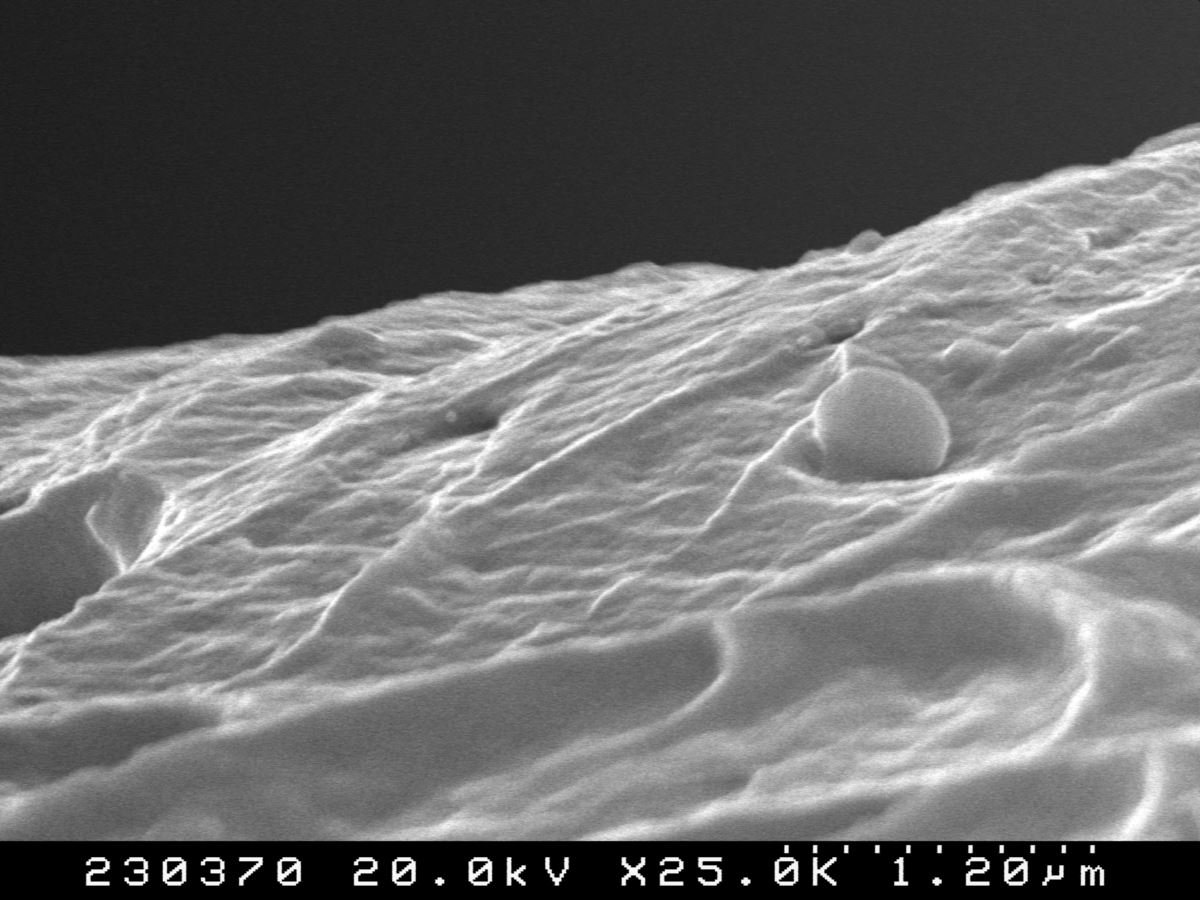
Alta evaluates coating integrity using optical microscopy and, when appropriate, scanning electron microscopy. SEM analysis can be performed in collaboration with a qualified partner laboratory to provide higher-magnification assessment and representative images of observed defects, anomalies, residues, or surface artifacts.
Coating integrity inspection may evaluate:
Coating cracks
Delamination
Flaking
Peeling
Surface artifacts
Abrasion marks
Webbing or bridging
Coating voids
Nonuniform regions
Particulate or debris on the device surface
Changes after simulated use
Devices We Test
Alta supports coating integrity and particulate testing for vascular and blood-contacting devices, including:
Stents and covered stents
Vascular grafts and stent grafts
Catheters and catheter-based devices
Delivery systems
Blood filters and embolic protection devices
Nitinol frames and implants
PET / polyester and ePTFE devices
Coated polymeric or metallic components
Other implantable or intravascular devices
Testing should be designed around the finished device, delivery system, intended use, and specific particulate risk questions.
Test Design and Study Outputs
A coating integrity or particulate testing program may include:
Device and procedure review
Identification of particulate risk points
Simulated-use model design
Tortuous path fixture selection or development
Sample preparation and device handling instructions
Particle collection method
Particle counting and sizing
Optical microscopy
SEM imaging, when appropriate
Comparison of coated vs. uncoated devices
Comparison of process or design iterations
Technical summary report with representative images
Study outputs may include particle counts by size range, representative images, observations of visible or microscopic particulate, coating integrity findings, and a written technical summary.
Coated vs. Uncoated or Process Comparison Testing
Coating and particulate testing is often most useful when used comparatively. Alta can help evaluate:
Coated vs. uncoated devices
New coating process vs. previous process
Different coating thicknesses
Different surface preparation methods
Different delivery system configurations
Design iteration A vs. design iteration B
Before and after simulated use
Prototype vs. production-intent samples
This comparative approach helps identify whether particulate or coating integrity findings are related to the coating, base device, delivery system, handling process, or test model.
Standards and Methods
Particulate evaluation for vascular devices draws on several complementary standards. AAMI TIR42:2021 provides the overarching, risk-based framework for evaluating particulate associated with vascular medical devices. USP <788> supplies the particle counting and sizing methods — light obscuration (Method 1) and light microscopy (Method 2) — along with widely referenced size thresholds. For simulated-use evaluation, ASTM F2394 describes a tortuous-path model that mimics deployment of a device through representative anatomy.
In practice these are used together: a device is deployed through a simulated-use model, particulate is collected, and particles are counted and sized by light obscuration or microscopy, with results interpreted against clinically relevant limits. Alta Biomed can help select the combination of methods appropriate to your device, materials, and intended use.
What you Receive
Depending on the study design, an Alta Biomed particulate evaluation typically provides:
Particle counts grouped by size range
Particle size distribution
Morphology and imaging of representative particulate, where relevant
Comparison against particulate specification limits, where a specification exists
Coating integrity assessment for coated devices, where applicable
Interpretation of results in the context of your device and its intended use
Protocols and reports prepared under our quality management system, suitable for use in your design control and regulatory documentation
This gives development teams practical, device-relevant data to support design decisions and particulate limit-setting during feasibility and development.
Frequently Asked Questions
What is acute particulate testing? Acute particulate testing evaluates the particulate matter a medical device may release during preparation and simulated clinical use. For blood-contacting and vascular devices, particulate shed into the bloodstream can pose a clinical risk, so characterizing how much a device releases — and where it comes from — is an important part of device development and safety evaluation.
What is AAMI TIR42? AAMI TIR42 (currently AAMI TIR42:2021, "Evaluation of particulate associated with vascular medical devices") is a technical information report that guides how to evaluate a vascular device's tendency to release particulate. It covers identifying particulate sources, selecting analytical methods, and establishing particulate limits based on clinical risk. It offers guidance rather than fixed numerical limits, since appropriate limits depend on the device and its clinical use.
How does USP <788> relate to particulate testing for devices? USP <788> ("Particulate Matter in Injections") describes methods for counting and sizing particulate — by light obscuration and by light microscopy. Although written for injectable products rather than devices, AAMI TIR42 and many device programs reference USP <788> methods and size thresholds when evaluating device-related particulate, so the two are often used together.
What is simulated-use particulate testing? Simulated-use testing evaluates particulate release while a device is deployed through a model that mimics its clinical use — for vascular devices, typically a tortuous-path anatomical model as described in ASTM F2394. This captures particulate generated during realistic handling, tracking, and deployment that a static test may miss.
Can you evaluate coating integrity and test coated devices? Yes. Coating integrity and particulate evaluation are closely related for coated devices, because coating damage during handling or deployment can be a source of particulate. Alta Biomed's coating background lets us assess coating condition alongside particulate — a combination most general particle-counting labs don't offer.
How is particulate collected and counted? Particulate is typically collected by flushing or extracting the device (often after simulated use), then counted and sized from the collected sample. The two common methods are light obscuration, which counts and sizes particles in a fluid, and light microscopy, which counts particles collected on a filter and allows visual assessment of morphology. The right method depends on the device, the particulate, and the study objective.
Can you compare coated vs. uncoated devices? Yes, and it's one of the most useful particulate studies during development. Testing a coated device against the same device uncoated, under identical conditions, helps isolate the coating's contribution to particulate from the device's baseline — especially informative during coating feasibility and process development.
What does a particulate testing report include? Reports generally include particle counts by size range, particle size distribution, and — depending on the study — morphology or imaging of representative particulate. Where a specification exists, results can be compared against particulate limits, and Alta can help interpret the data in the context of the device and its intended use.
Why Alta Biomed
Alta Biomed combines medical device coating expertise with practical testing support for coated and blood-contacting devices. Our team understands the challenges associated with thin-film coatings, vascular device geometries, surface characterization, simulated use, particulate risk, and coating integrity evaluation.
Alta can support early feasibility studies, coating process development, design iteration comparisons, simulated-use testing, coating inspection, acute particulate testing, and follow-on hemocompatibility testing.
Need to evaluate coating integrity or acute particulate generation for a coated medical device? Contact Alta Biomed to discuss simulated-use testing, tortuous path fixture development, microscopy, and particulate assessment.